

How to Add Quantity-Based Costs (Quantity Breaks)
Atualizado em 2 de outubro de 2026
Quantity breaks let a product's unit cost depend on how many units a customer orders. Use them when your supplier gives bulk discounts, for example $8.50 per pillow for small orders but $7.90 from the fifth unit on.
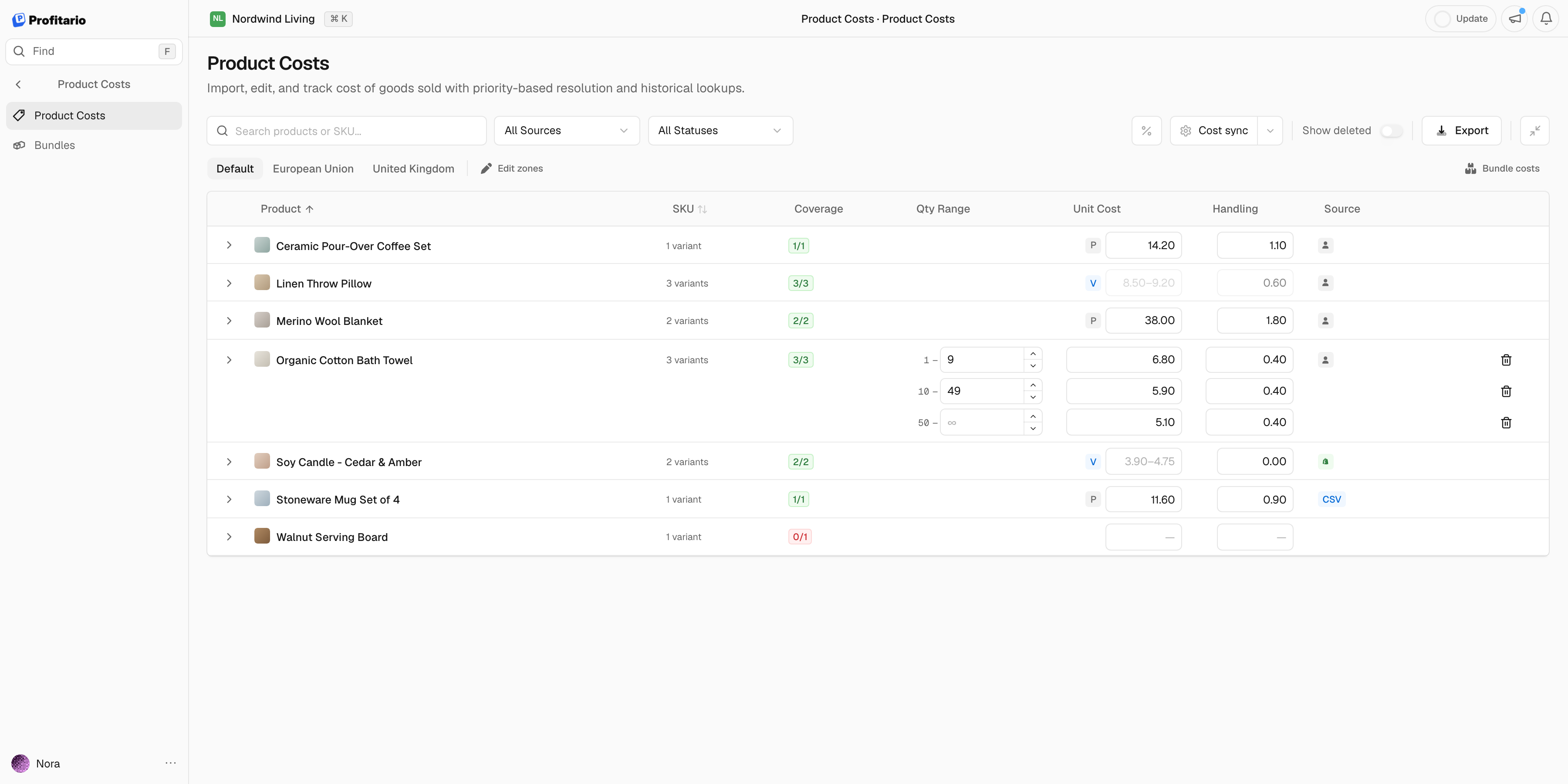
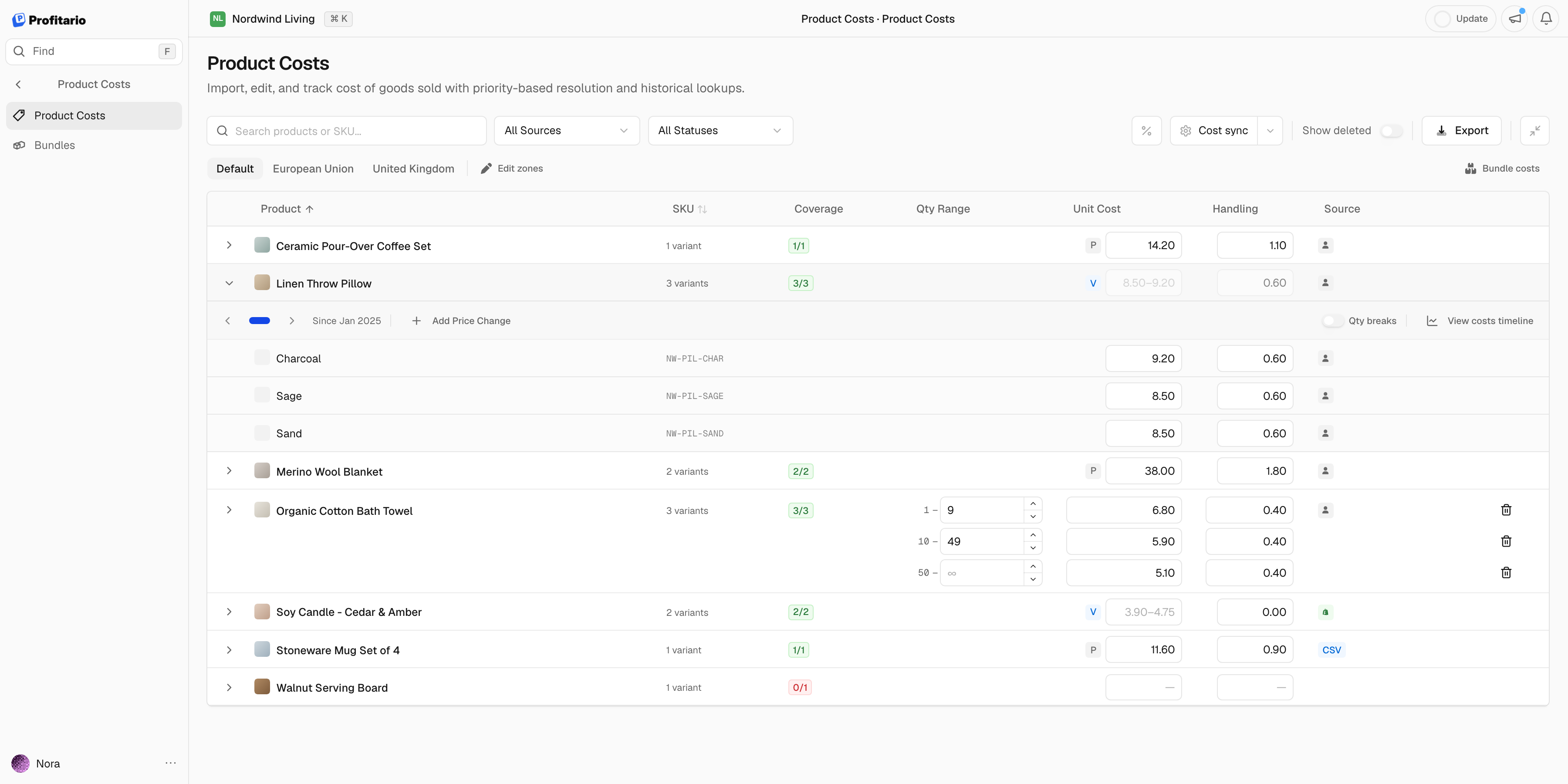
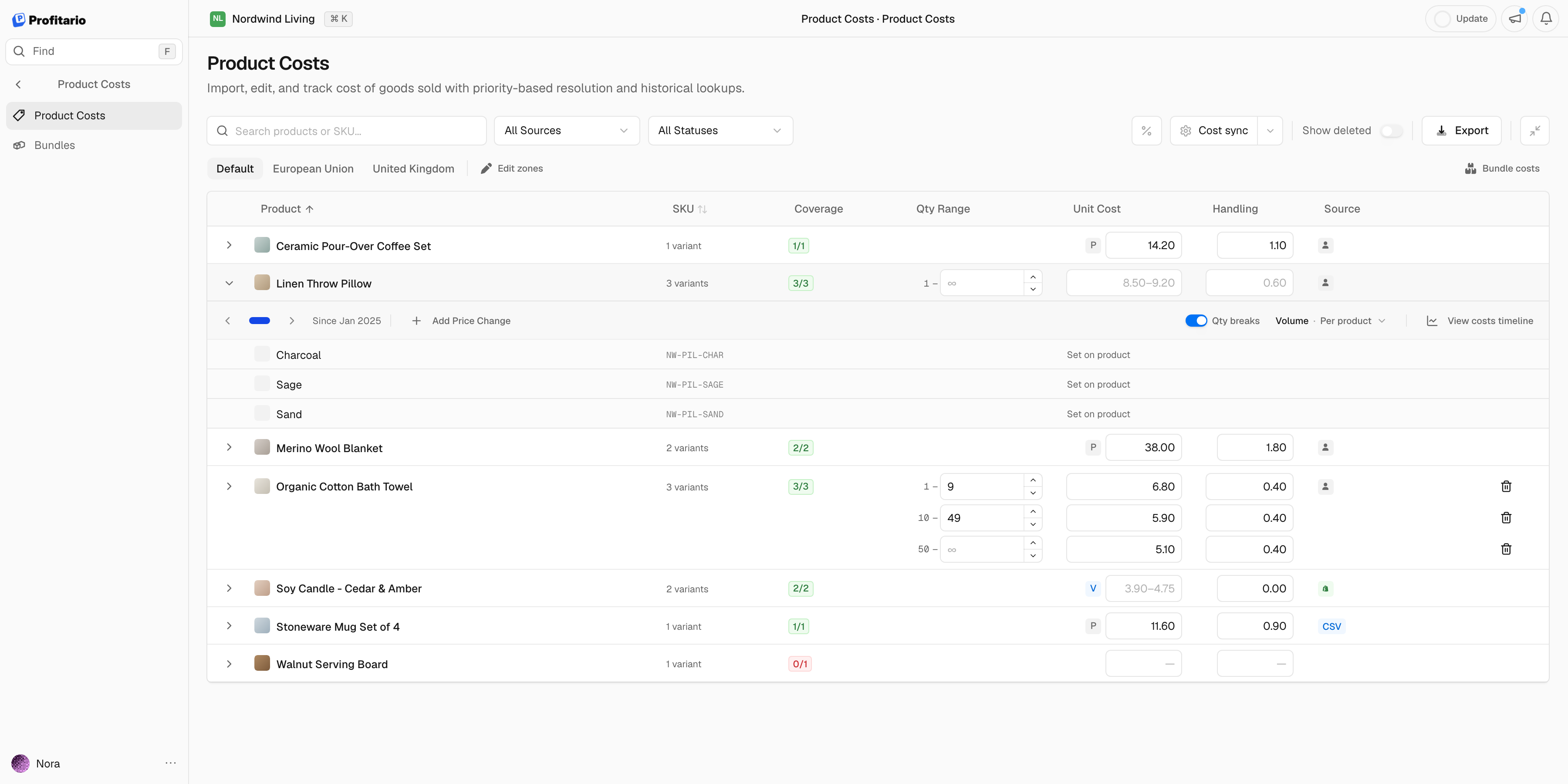
Turn On Quantity Breaks#
Set Up the Tiers#
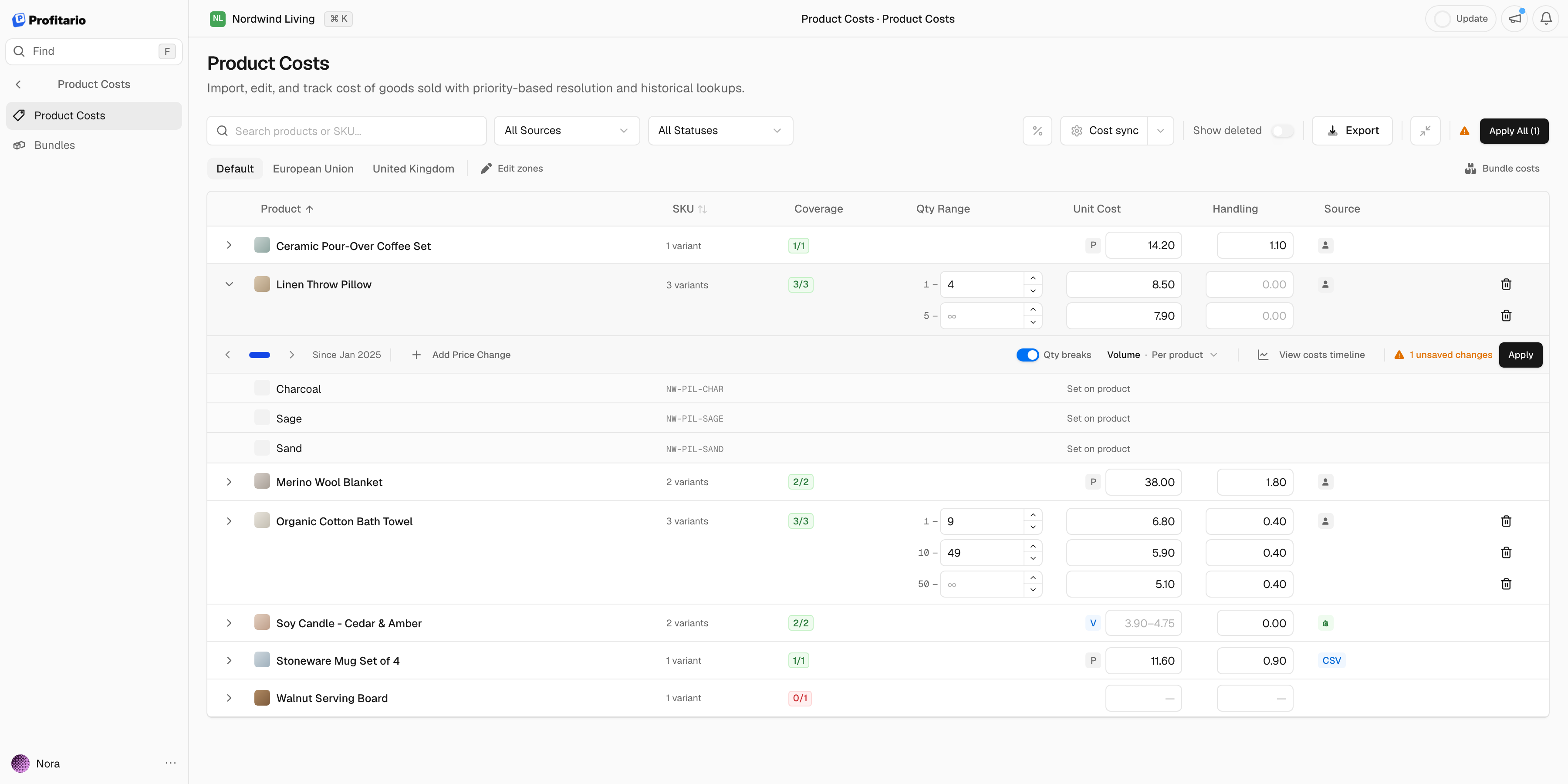
In the screenshot, the pillow costs $8.50 per unit for 1 to 4 units and $7.90 per unit from 5 units on.
If your supplier quotes a price for a pack, break it down to a per-item cost before entering it. Example: a pack of 10 towels costs $59.00, so enter $59.00 ÷ 10 = $5.90 as the unit cost.
Choose How Tiers Apply to an Order#
Once Qty breaks is on, a menu next to the toggle decides two things: how the units of an order are priced, and which units are counted.
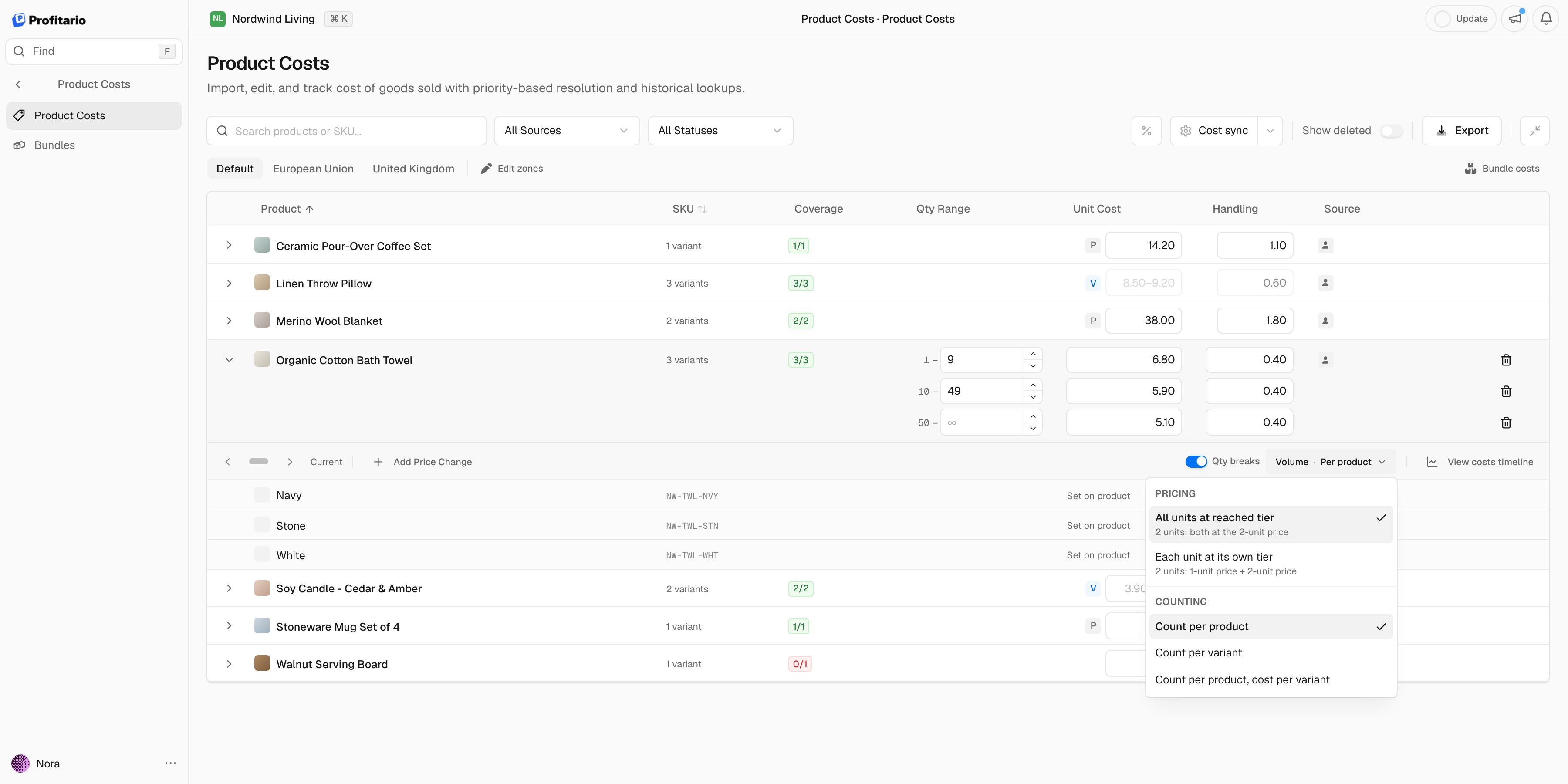
Both choices are saved as soon as you pick them, and the product's orders are recalculated.
Pricing
Take a product with two tiers: 1 unit costs $8.53, 2 or more cost $6.27 each. An order contains 2 units.
| Pricing | Shown in the menu as | Cost recorded for the 2 units | Pick it when |
|---|---|---|---|
| All units at reached tier | Volume | 2 × $6.27 = $12.54 | Your supplier bills the lower price on every unit |
| Each unit at its own tier | Tiered | $8.53 + $6.27 = $14.80 | Only the additional units are discounted (second unit deal) |
All units at reached tier is the default.
Counting
- Count per product (default): every variant of the product in the order counts together. Three colours of the same shirt at one unit each make 3 units, so all three use the 3+ tier. The tiers are set once on the product row and apply to every variant; variant rows show Set on product.
- Count per variant: each variant counts on its own. The same order gives each colour 1 unit, so each uses the 1-unit tier. Tiers are set per variant; the product row shows Set per variant.
- Count per product, cost per variant: every variant of the product counts together, like the first option, but each variant keeps its own tiers. Use this when the variants share the bulk discount but not the price, for example a size with a supplier surcharge. Tiers are set per variant; the product row shows Pooled, set per variant.
In the screenshot, the polo shirt uses Count per product, cost per variant: the Green and Navy variants share one set of tiers, and the Khaki / XXL variant carries a surcharge on every tier. All three still count together in an order.
In every counting mode, several lines of the same variant in one order count together.
Compare the three counting modes
The comparison below uses the pricing All units at reached tier.
The polo shirt below has three variants. Green / M and Navy / M cost the same; Khaki / XXL carries a supplier surcharge on every tier. Under Count per product every variant uses the product's shared tiers instead.
The four orders below show what each mode records as product cost. The grey pill in each cell shows how many units the tier lookup counted for that line, and which tier that reached.
Order #6399 has one unit of each colour. Counting per product puts all three lines on the 3+ tier at the product's shared cost ($34.98). Counting per variant leaves each line at its 1-unit tier ($52.16). Counting per product with cost per variant uses the 3+ tier for every line, but Khaki keeps its own 3+ price of $12.80 ($36.12).
Order #6402 has two Green and one Khaki. Per variant, the two Green units reach the 2-unit tier while Khaki stays at its 1-unit tier ($44.40). The two modes that count per product see 3 units for every line.
Order #6407 contains a single Khaki. The two modes that use variant tiers agree ($18.50). Counting per product uses the product's shared 1-unit cost instead ($16.83).
Order #6411 has three Navy. All three modes count 3 units of the same variant and record the same cost ($34.98). The selector only matters when an order mixes variants of the product.
Perguntas frequentes
Este artigo foi útil?